CRITICAL
APPRAISAL
and epidemiology
Diagnostic and screening tests
Clinicians use diagnostic or screening tests at some stage for the vast majority of their patients. Often, patients and
doctor assume that the test is 100% accurate but this is never the case. Sometimes, false positive and false negative
results can be actively harmful to the patient - for example, when screening tests for cancer are used. It is important
for both doctor and patient to understand the limitations of the test, and how likely it is to tell them both if the condition
really is present or absent. This is particularly important at the moment for Covid-19 tests.
It can be confusing trying to remember exactly what these terms mean when describing how good a test is. Sensitivity
and specificity look at the overall ability of a test to correctly identify or exclude a condition in a group of patients, while
positive and negative predictive value look at the performance of a test at an individual level, and refer to the
probability of a person with a positive or negative test result actually having or not having the condition.
The basic idea of diagnostic test interpretation is to calculate the probability a
patient has a disease under consideration given a certain test result. A 2 by 2
table is used as a mneumonic device. Be sure to label the table with the test
results on the left side and the disease status / “gold standard” on top as
shown here:

Click below for example and self test
The predictive value of a screening test measures the true presence or absence of a disease.
Predictive value has two components:
1.
The positive predictive value which is the proportion of true positives among all positives (A/A+B)
2.
The negative predictive value which is the proportion of true negative among all negatives
(D/C+D)
The Relationship Between Prevalence & the Predictive Value of a Test
In general the usefulness of a diagnostic screening test is affected by the prevalence of a disease. If the
prevalence of a disease is low, the positive predictive value is likely to be low, if the prevalence of the
disease is high the positive predictive value is also likely to be high.
There are links below
explaining sensitivity and positive
predictive value.
The green boxes have self tests.
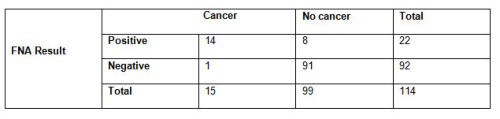
A study is undertaken to compare the results of fine needle biopsy with the
findings from surgical breast biopsies in women without a palpable mass.
Surgical biopsy results
This is an example of a "two by two" table to present the FNA results and compare them
against the "gold standard" of surgical biopsy. Here, A = 14, B = 8, C = 1, D = 91
The sensitivity of a fine needle biopsy is A/(A+C) x 100%
14/(14+ 1) x 100 = 93%
The specificity of a fine needle biopsy is D/(B+D) x 100%
91/(8+ 91) x 100 = 91%
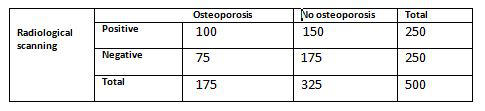
100 women tested positive and had osteoporosis, 150 tested positive but subsequently
were found not to have the disease. Of the 250 who tested negative, 75 had osteoporosis
and 175 did not. The sensitivity of the scanning test is (select the correct answer):
(a) 175 / (150 + 175) x 100%
(b) 100 / (100 + 150) x 100%
(c) 150 / (150 + 175) x 100%
(d) 150 / (100 + 150) x 100%
(e) 100 / (100 + 75) x 100%
(f) 175 / (75 + 175) x 100%
A new radiological scanning tool for the early detection of osteoporosis was used
to evaluate 500 patients. The results were as follows:
Self test answer
A new radiological scanning tool for the early detection of osteoporosis was used to
evaluate 500 patients. The results were as follows:
100 women tested positive and had osteoporosis, 150 tested positive but
subsequently were found not to have the disease. Of the 250 who tested negative,
75 had osteoporosis and 175 did not.
Results
A = 100, B =150, C = 75, D = 175
The sensitivity of the scanning test is A/(A+C) x 100%
100 / (100 + 75) x 100 = 57.1%
A study is undertaken to compare the results of fine needle biopsy with the
findings from surgical breast biopsies in women without a palpable mass.
Surgical biopsy results
This is an example of a "two by two" table to present the FNA results and compare them
against the "gold standard" of surgical biopsy. Here, A = 14, B = 8, C = 1, D = 91
The positive predictive value of a fine needle biopsy is A/(A+B) x 100%
14/(14+ 8) x 100 = 63%
The negative predictive value of a fine needle biopsy is D/(C+D) x 100%
91/(1+ 91) x 100 = 98%
Predictive value self test
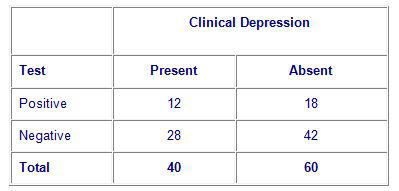
A new screening test for depression is developed.
What is the positive predictive value of the test?
What is the negative predictive value?
Answers
T
The positive predictive value is
12/ (12 +18) = 0.4
The negative predictive value is
42/ (28 + 42) = 0.6
Predictive value self test
A new screening test for depression is developed.