CRITICAL
APPRAISAL
and epidemiology


Study Design

High-fat diet
Hepatitis B infection
(exposures)
Breast cancer
Liver cancer
(outcomes)

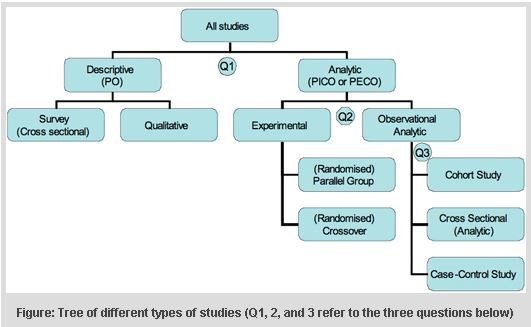
Q1. What was the aim of the study?
1.
To simply describe a population (PO questions)
descriptive
2.
To quantify the relationship between factors (PICO questions)
analytic.
Q2. If analytic, was the intervention randomly allocated?
1.
Yes?
RCT
2.
No?
Observational study
3.
For observational study the main types will then depend on the timing of the
measurement of outcome, so our third question is:
Q3. When were the outcomes determined?
1.
Some time after the exposure or intervention?
cohort study (‘prospective study’)
2.
At the same time as the exposure or intervention?
cross sectional study or survey
3.
Before the exposure was determined?
case-control study (‘retrospective study’
based on recall of the exposure)


Select one of the types of trial for a description below
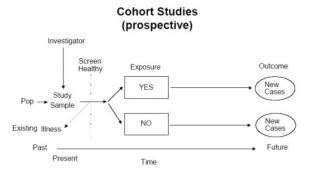
In a cohort study, a group of individuals exposed to a putative risk factor and a group
who are unexposed to the risk factor are followed over time (often years) to
determine the occurrence of disease. The incidence of disease in the exposed group
is compared with the incidence of disease in the unexposed group. The relative risk
(incidence risk or incidence rate) is used to assess whether the exposure and
disease are causally linked. Cohort studies may be prospective or retrospective. A
prospective cohort study is also called a concurrent cohort study, where the subjects
have been followed up for a period and the outcomes of interest are recorded.
Selection of subjects for a cohort study is influenced by various factors including:
•
the type of exposure under investigation
•
the frequency of the exposure in the population
•
accessibility of subjects and likelihood of continued participation
Both exposed and non exposed subjects must be free of the condition under
investigation at the start of the study and must be equally eligible to develop the
disease during the course of the study. A cohort study is usually prospective i.e.
starting now and looking forward or retrospective based on information on prior
exposure and disease status. Prospective studies have the advantage of allowing
accurate measurement of exposures and confounding but the disadvantage of being
more expensive and taking years for the final result. Retrospective studies give less
accurate results but are cheaper and are a short cut to studying diseases with a long
time lag between exposure and onset of disease.
Potential sources of bias, analysis, strengths and weaknesses of cohort studies
The randomised controlled trial is considered as the most rigorous method of
determining whether a cause-effect relationship exists between an
intervention and outcome.2The strength of the RCT lies in the process of
randomisation which is unique to this type of study design.
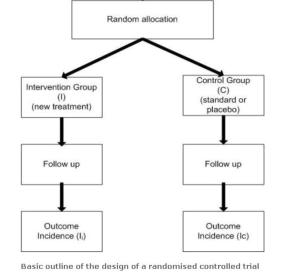
Generally, in a randomised controlled trial study participants are randomly
assigned to one of two groups, the experimental group who will receive the
intervention being tested, and a comparison group (controls) who receive a
conventional treatment or placebo. These groups are then followed
prospectively to assess the effectiveness of the intervention compared with
the standard or placebo treatment.
Subjects are randomly allocated to the two study arms so that the intervention
and control groups are as similar as possible in all respects, apart from the
treatment. Potential confounding factors should be equally distributed
between the two groups. The choice of comparison treatments may include
an existing standard treatment or a placebo. A placebo is a substance that
resembles the intervention treatment in all respects except that it contains no
active ingredients.
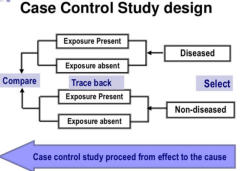
Case control studies are studies in which patients who already have a certain
condition are compared with people who do not. They are appropriate where an
outcome is rare or harmful. For example: a study on which lung cancer patients
are asked how much they smoked in the past and the answers are compared with
a sample of the general population would be a case control study. Case control
studies are less reliable than either randomized controlled trials or cohort studies.
Just because there is a statistical relationship between two conditions does not
mean that one condition actually caused the other. For instance, lung cancer
rates are higher for people without a college education (who tend to smoke
more), but that does not mean that someone can reduce his or her cancer risk
just by getting a college education.
The main advantages of case control studies are:
•
They can be done quickly. By asking patients about their past history,
researchers can quickly discover effects that otherwise would take many
years to show themselves.
•
Useful for studies of rare diseases
Disadvantages are:
•
May not be able to get accurate information about potential risk factors, or
confounding variables
•
Prone to selection bias and recall bias (difficulty recalling whether exposure
or disease came first)
•
May be difficult to assemble a representative case group and control group
Design, application, strength and weaknesses of case control studies
In general terms, qualitative research methods are utilised in order to study
people in their natural social settings (naturalism), with the focus of
research being on the meanings and understandings that individuals and
social groups attach to their social world. In a public health context,
qualitative research methods would therefore typically be deployed in
evaluating the implementation of a public health intervention in situ,
specifically in terms of assessing its impact on the subjective health beliefs,
health knowledge and behaviour of the targeted population.
The type of research questions addressed within a qualitative inquiry are
thus different from those addressed by quantitative research but equally
valid. In follows therefore, that any attempt to compare the outcomes of
qualitative and quantitative research is ultimately a fruitless endeavour
precisely because the two approaches employ very different
epistemological assumptions (the study of how we come to acquire
knowledge of the external world). Nevertheless, this understanding does
not prevent the use of combined or 'mixed' methods within health research,
and indeed this is increasingly a requirement for research proposals in the
field of public health and health care.
Qualitative methods are generally utilised in order to generate hypotheses
rather than with the testing of hypotheses. When qualitative health
research first emerged in the 1980s, the main issue that arose surrounding
its utility as a mode of inquiry concerned the generalisability of its findings
as it was not seen to be 'objective' in the same way that quantitative
research was. Today, qualitative methods now play an increasingly
important role in health services research. Qualitative methods are now
utilised to address the well-documented 'gap' between evidence-based
approaches based on the findings of randomised control trials and the
practice of clinical decision-making in individual cases.
Presenting qualitative research
A systematic review draws together the results of several primary
research studies. They are used when there is an important clinical
question, but many clinical trials, perhaps with conflicting results. A
systematic review seeks to provide an overview of the findings of the
individual trials, highlighting possible answers, as well as any remaining
gaps in knowledge.
The Cochrane Collaboration defines a systematic review as 'a review of
a clearly formulated question that uses systematic and explicit methods
to identify, select, and critically appraise relevant research and to collect
and analyse data from studies that are included in the review.'
Systematic reviews synthesize the results of multiple primary
investigations by using strategies that limit bias and random error. These
include a comprehensive search of all potentially relevant articles. In the
past literature reviews were not as rigorous, and were often compiled by
experts writing with a particular point of view, making dispassionate
analysis difficult to achieve. It is thought, for example, that if original
studies of the effects of anti-platelet therapies after myocardial infarction
had been systematically reviewed the benefits of therapy would have
been apparent as early as the mid-1970s.
Systematic reviews and meta-analysis
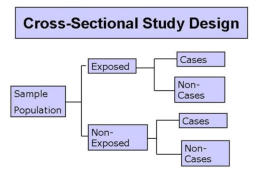
A cross-sectional study examines the relationship between disease (or other
health related state) and other variables of interest as they exist in a defined
population at a single point in time or over a short period of time (e.g. calendar
year). Cross-sectional studies can be thought of as providing a snapshot of the
frequency of a disease or other health related characteristics (e.g. exposure
variables) in a population at a given point in time. Cross-sectional studies are
used to assess the burden of disease or health needs of a population and are
particularly useful in informing the planning and allocation of health resources.
Types of cross-sectional study
Descriptive: A cross-sectional survey may be purely descriptive and used to
assess the burden of a particular disease in a defined population. For example a
random sample of schools across London may be used to assess the prevalence
of asthma among 12-14 year olds.
Analytical: Analytical cross-sectional surveys may also be used to investigate
the association between a putative risk factor and a health outcome. However
this type of study is limited in its ability to draw valid conclusions as to the
association between a risk factor and health outcome. In a cross-sectional survey
the risk factors and outcome are measured simultaneously, and therefore it may
be difficult to determine whether the exposure proceeded or followed the disease.
In practice, cross-sectional studies will include an element of both types of
design.
Advantages and disadvantages of cross sectional studies